TADICO Takes a Strategic Step Toward Feed Self-Sufficiency; Goldasht Launches 1,000-Hectare Forage Corn Cultivation Project in Dezful
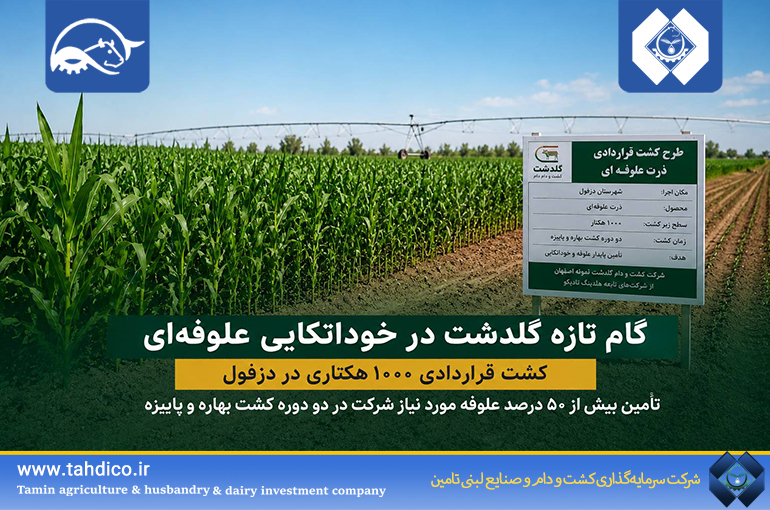
Goldasht Nemooneh Isfahan Agriculture and Livestock Company, a subsidiary of TADICO Holding, has taken a significant step toward securing a sustainable supply of livestock feed and increasing forage self-sufficiency by implementing a contract-based forage corn cultivation project across 1,000 hectares of agricultural land in Dezful County. The project is expected to supply more than 50% of the company’s forage requirements.
According to TADICO:
The project is being implemented under the supervision of the company’s Agricultural Affairs Department in two cultivation cycles—spring and autumn. In each cycle, 500 hectares are allocated to contract-based cultivation, bringing the total area covered by the project to 1,000 hectares.
The initiative forms part of Goldasht’s strategy to complete its production value chain, manage livestock feed costs, reduce reliance on external sources, and mitigate risks arising from fluctuations in the livestock-input market. Based on the company’s plans, more than half of its forage requirements are expected to be met through this project, which could play a significant role in reducing production costs and ensuring greater stability in livestock feeding plans.
In this regard, Hadi Babaahmadi, Head of Agricultural Affairs at Goldasht Nemooneh Isfahan and the project’s coordinator, emphasized the importance of contract farming, stating that the primary objective of the program is to establish a reliable supply chain for the company’s forage requirements. According to him, meeting a substantial portion of the company’s forage needs through contract cultivation will not only reduce dependence on external markets but also enable more effective cost management and enhance the resilience of the production chain.
According to the assessments conducted, appropriate land selection and suitability assessment, allocation of inputs and equipment, farm management, financing, and establishing trust and coordination among farmers have been identified as key strengths of the project. Meanwhile, continued commitment by both parties, ongoing monitoring, efficient use of water and soil resources, access to specialized equipment, and guaranteed purchase agreements have been recognized as important factors contributing to the success and further development of this model.
The implementation of contract-based forage corn cultivation across 1,000 hectares in Dezful represents a practical step toward reducing production costs, managing feed-supply risks, increasing forage self-sufficiency, and completing Goldasht’s value chain. Continuing and expanding this approach can, over the long term, reduce dependence on the livestock-input market, enable more effective use of agricultural capacities, and strengthen the resilience of the production chain for both Goldasht and the broader TADICO Holding.
The initiative forms part of Goldasht’s strategy to complete its production value chain, manage livestock feed costs, reduce reliance on external sources, and mitigate risks arising from fluctuations in the livestock-input market. Based on the company’s plans, more than half of its forage requirements are expected to be met through this project, which could play a significant role in reducing production costs and ensuring greater stability in livestock feeding plans.
In this regard, Hadi Babaahmadi, Head of Agricultural Affairs at Goldasht Nemooneh Isfahan and the project’s coordinator, emphasized the importance of contract farming, stating that the primary objective of the program is to establish a reliable supply chain for the company’s forage requirements. According to him, meeting a substantial portion of the company’s forage needs through contract cultivation will not only reduce dependence on external markets but also enable more effective cost management and enhance the resilience of the production chain.
According to the assessments conducted, appropriate land selection and suitability assessment, allocation of inputs and equipment, farm management, financing, and establishing trust and coordination among farmers have been identified as key strengths of the project. Meanwhile, continued commitment by both parties, ongoing monitoring, efficient use of water and soil resources, access to specialized equipment, and guaranteed purchase agreements have been recognized as important factors contributing to the success and further development of this model.
The implementation of contract-based forage corn cultivation across 1,000 hectares in Dezful represents a practical step toward reducing production costs, managing feed-supply risks, increasing forage self-sufficiency, and completing Goldasht’s value chain. Continuing and expanding this approach can, over the long term, reduce dependence on the livestock-input market, enable more effective use of agricultural capacities, and strengthen the resilience of the production chain for both Goldasht and the broader TADICO Holding.